Did you know that most abolitionists were also advocates for equality of the sexes?
Theodore Weld, who trained abolition activists and eventually married Sarah Grimke, was legendary for his courage. Despite criticism, he welcomed women into the abolition movement and insisted on treating them as autonomous equals.
In fact, the abolition movement is what kicked off the American Woman's Rights Movement. Weld trained women alongside men and treated them as self-governing equals in every way.
Weld and Grimke's egalitarian marriage lasted happily for over four decades.
Another well-known abolitionist was Frederick Douglas, who declared that he was proud to be denominated as a woman's rights man.
Does our Creator use women and children as curses and threats like early Hebrew rabbi's did...and Bible translators (of all nationalities) still do.
For example, Isaiah 3:12 is consistently translated as: As
for my people children are their oppressors and womenrule over them. But translators routinely point out the alternate translation of: "As for my people abusersare their
oppressors and exacters (tax collectors) rule over them."
Comments:Isaiah 3:12“I think we find another case of prejudiced translation in Isaiah 3:12. The
word translated “children” in this verse in Isaiah, is a plural masculine
participle of the verb “to glean,” “abuse,” “practice.” It is translated
“glean” in Leviticus 19:10, Deuteronomy 24:21, Judges 20:45, and Jeremiah 6:9.
The word has no
translation such as “children” anywhere else in the Bible, and it occurs 21 times. Another word altogether is used
for “children,” and “child,” in verses 4 and 5 of this same chapter;the
sense [in verse 12] seems to have been fixed by the supposed context, to correspond with
“women.”
As to the word
translated “women:” [The] two words [women and exacters], without the rabbinical vowel points, are exactly
alike. One is pronounced nosh-im
and the other na-shim. In appearance the only difference is a slight
mark under the first letter of the Hebrew word na-shim. The first word
means “exactors;” the one with a vowel mark under the initial letter means
“women.”
The entire decision,
therefore, as to whether the word means one or the other depends upon OPTION.
Those who pointed the
word, evidently thought the nation could sink no lower than to pass under women
rulers, and then translated the word “children” to match it. Commentators frequently call attention to the alternate
reading." (all emphasis mine)–100 Bible Studies on Woman’s Place in the
Divine Economy by Katharine C. Bushnell (1856-1946)
~~~
For more information on the subject of God and Women, subscribe to mydedicated columnat Substack and to mydedicated playliston YouTube. My book on the subject is free to Kindle Unlimited subscribers.
According to Gallup, there is a great de-churching going on. Reformed ministers write books and publish articles on why they believe this is happening. Dollars to donuts they don't mention the fact that many couples walk away from church membership and attendance because of complementarianism, the unscriptural teaching and practice of male governance in churches and homes.
Can anyone explain to me how Jesus can be ELOHIM of Israel and YAHWEH (that would mean he is the Most High God) and yet be subordinate at the same time, as patriarchal/complementarian scholars claim in their heretical and hierarchical eternal sonship theology?
Ezekiel and John both identify Jesus as being the God of Israel. And, of course, we have the plain statement of Thomas--"My LORD and my GOD." How many Gods would a Jewish man have had?
There are many scriptural witnesses to the fact that Jesus is YAHWEH, Ezekiel 43:1-3 as compared to Revelation 1:13-15 being just two of them.
Afterward he
brought me to the gate even the gate that looks toward the east And
behold the glory of ELOHIM of Israel came from the way of the
east and his voice was like a noise of many waters and the earth shined
with his glory3: And it was according to the appearance of the
vision which I saw even according to the vision that I saw when I came to
destroy the city and the visions were like the vision that I saw by the river
ChebarEK 1:26-28and I fell upon my
face
Jesus is ELOHIM of
Israel whose voice is as the noise of many waters Revelation 1:13-15.
Jesus [The WORD John 1:1] is the one who was on the throne at the
river Chebar, the one Ezekiel described as the appearance and Glory
of YHWH EK 1:26-28.
There is no hierarchy within the Godhead. And as such, according to prominent complementarian scholars, there can be no gender-based hierarchy within marriage, ministry, or anywhere else.
There is a connection between gender-based hierarchy among humans and hierarchy within the Godhead. The Bible says, "Out of the mouths of two or three witnesses, let every word be established."
The number of scriptural witnesses that Jesus is the Almighty is a whole lot more than just two or three. That means the number of scriptural witnesses to biblical equality/autonomy of the sexes is a whole lot more than just two or three.
Luke 2:1-7 [emphasis on verse :7], gives a perfect illustration as to why women were exempted from the requirement for all Hebrew males to attend the three mandatory Feasts of the LORD in Jerusalem each year--regardless of how far away they lived.
In Luke chapter two, we read that Caesar Augustus commanded every person [regardless of sex or age] in all the world [meaning those under his jurisdiction, i.e., the Roman Empire] to be taxed. Because of this command, at nine-months pregnant, the mother of Jesus was required to make an arduous journey to the town of her birth and deliver her baby, the Messiah, the Savior of the world, in an unsanitary stable, surrounded by livestock.
In the TORAH, we read that only Hebrew males are commanded to attend three of the seven annual Feasts of the Lord. The male-only requisite had nothing to do with male superiority but rather with protection of mothers, newborns, infants, toddlers, and children.
At feast-time in Israel, at any given time, how many expectant or newly-delivered mothers would have been in the midst of or on the verge of delivery or going through required purification periods after giving birth? How many mothers would have been caring for newborns, sick infants or children?
Can anyone imagine the mother and infant mortality rate if these women had been required to make a seven-day [not counting travel-time] thrice-yearly pilgrimage to Jerusalem?
Yahweh is more merciful to his people than any earthly government. And fallen human nature tends to turn the kindness and mercies of God into excuses to build sinful and harmful hierarchies.
God is moving among his young people and raising up advocates for biblical equality of the sexes.
Many of us who have been advocating for biblical equality of the sexes, are getting up in age. I am approaching my 67th birthday and have been advocating for almost 2 decades.
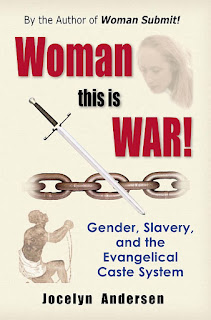
I started writing, Woman Submit! Christians & Domestic Violence, in 2005, and the Lord immediately began dealing with me about writing, Woman this is WAR! Gender Slavery and the Evangelical Caste System. He made it clear that if I only ran with the message of preventing domestic violence, without addressing the root cause, "other side of the coin" so to speak, which is complementarianism/male headship, that I would be running only half-dressed.
I am thrilled to see God raising up a veritable army of young advocates. This is a growing movement among young Christians. For that reason, in addition to my books, I put together a "Quick Link Resource Guide for Advocates of Biblical Equality," which consists of links to over 100 of my articles on the topic, all conveniently located on one webpage for quick reference.
I am 100% committed to supporting advocates of any age.
Does that statement make anyone besides me want to hurl their accounts into the chamber pot?
Aside from a few soundbites of the politician making this statement, the only objection it drew was from a few blogs, a few discussion forums. The social media dust storm, that should have formed over it, never happened.
Chivalrous drivel (Yes, I did say drivel) such as this, does nothing to empower women, nor is it healthy for men and boys.
The concept of chivalry does not mean — nor has it ever meant — common courtesy.
Everyone should practice common courtesy and cultivate respectful attitudes and behavior toward all people, regardless of sex.
When the idea of chivalry was first concocted, it had zero practical application. It was all a big romantic show, play-acting with absolutely no substance.
Let’s get this straight, women were not revered in the days of chivalry, nor were they protected. Women had no social or legal status beyond that of their most powerful male relative. Women had no recourse against domestic violence or abuse (which they needed protection from more than anything else). Both in public and behind closed doors, women had a place, were expected to stay their place, and faced sometimes devastating consequences if they did not — nothing new then or now.
Chivalry was a demeaning and fraudulent concept to medieval women. It is still so when applied to present-day women.
How so you ask?
In, Recovering Biblical Manhood and Womanhood: A response to Evangelical Feminism, John Piper instructs men in how to subliminally exercise male authority over women who may be their superiors in the workplace by using exaggerated courtesies, such as speaking softer to women than to men, opening doors, and offering their chairs to women. Is that not chivalrous? To a tee it is.
But Piper's advice makes a mockery of common courtesy. It is insincere, condescending, contemptuous, and demeaning. “Courtesies” extended from such motives should rightfully be scorned.
In explaining how courtesies can be used to masculine advantage, Piper, who also writes that it is inappropriate for women to hold equal or superior positions to men in the workplace, shames men and advises that they might want to consider changing jobs as a long-term solution to having a female boss. He says real men are not able to tolerate working for women.
Man-shaming is common among complementarians. Men who buy into it, are psychologically crippled and trapped in a belief-system that places expectations on them that they can never fulfill.
Let's be clear, men do not have a “chivalrous” responsibility to women — only a responsibility to treat everyone, including women, with respect and common courtesy.
Should the physically stronger always be ready to protect the physically weaker — regardless of age or sex? Absolutely. Try snatching a baby away from a mother and see what happens. Try assaulting a woman in front of her husband, boyfriend, father, brother, or any male friend who cares about her, and see what happens.
Nothing is 100%, but most people are ready to stand and defend those they care about. Many are ready to stand and defend (within their power) anyone who needs help. These things are not what this article speaks to but rather the rhetoric and misogynistic concept of “chivalry,” which is one of the oldest and most flourishing shams in history, ... and, shamefully, is still espoused today, as evidenced by almost a half-million results in the internet search on "How to be chivalrous."
The medieval concept of chivalry harks back to feudal times when cultural and legal systems forced women into total dependence on men for just about everything. Provision and protection was not something women had access too, unless they had a husband, father, brother, or other male guardian. It is only in relatively recent times this has changed in the United States, but women and children without male providers are still statistically disadvantaged.
Chivalry was an ancient double-edged sword that provided a social facade of protecting women while keeping them in their proverbial “places.”
In the days of chivalry, as in today's patriarchal complementarian movement, women had limited protection from the men who claimed to keep them safe. With few variations, it has a modern-day counterpart in the organized crime “protection racket.”
“Pay (submit to) me (stay in your “place”) and I’ll protect you.”
“Who do I need protection from?”
“Why, from meof course!”
Let’s give benefit of the doubt, that the concept of chivalry, that women should be revered and protected, has not been thoroughly thought through by contemporary people just as the popular term “rule of thumb” has not been thought through, but that’s for another article. Let’s assume they simply do not understand its implications and sincerely believe chivalry is no different from common courtesy, which is a good thing. But our job is to inform and educate. So, here goes with one not-so-small example….
The notion that women need to be “revered” should terrify any woman. Why? Because revering a woman, “putting a woman on a pedestal,” is one of the early-warning-signs that a woman might be dating a potential abuser or batterer. This is red flag behavior.
Women are not asking for special treatment. They do not need, nor do they want, to be “championed and revered,” … unless the “championing” part is in favor of absolute and Constitutional autonomy and equality with men.
The idea of “championing” women (unless it's championing autonomous equality) is obsolete and unhealthy for both women and men. It is a continuation of a hypocritical and medieval idea that should have went the way of the dinosaur and jousting matches long ago but remains firmly entrenched as the double-edged sword it has always been. A thorn in the flesh to modern-day women and men.
The misguided idea of chivalry stands in the way of existential and Constitutional autonomous equality of the sexes.
What about equal pay acts, or violence against women acts, or anti-discrimination acts? These are civil laws not Constitutional Rights and would not be necessary if women were protected under the Constitution in the same way men are.
Women ask only the respect due them as human-beings created in the image of God and born with the same “inalienable,” existential —innate and God-given—rights as men. Many men do champion the cause of Constitutional equality for women, and our thanks go out to them.
Did you know that the United States is one of the only free countries that does not have an Equal Rights Amendment? Pictured above: Ryan Watson went the distance with me in the 2012 Warrior Dash. We ran in support of the Equal Rights Amendment. We brought much needed attention to it and were almost unrecognizably mud-stained [head to toe] by the time we finished. It was AWESOME!
This writer is not saying there are no differences between men and women (Thank God for differences!), just that the differences are no basis for inequality and abridged autonomy. Reasonable people acknowledge and celebrate differences between the sexes without the need for gender-based hierarchy and phony fronts of outdated and overstated courtesies (chivalry) to keep harmful boundaries of social and Constitutional inequality in place.
Below is a picture that illustrates one remarkable difference between the sexes. You can read the story behind it HERE. But be warned, it's emotional.
A man might do this to his truck (unlikely though not impossible), but the driver of this 18-Wheel driver is a strong and courageous woman — who is not ashamed of being a woman — making a very special delivery.
Common courtesy and respect that establishes and reinforces equality is in. Exaggerated and outdated ideas about chivalry, that establish and reinforce inequality is out.
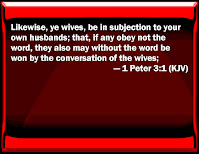
Likewise
the women yield to your own men that if any obey not the word they also may
without The Word be won by the behavior of the wives [1]
[1] In 1 Peter 3:1, is the writer telling wives that they are basically slaves and should emulate the subjective
behavior of slaves as instructed in 1 Peter 2:18?
This writer does not believe
so. Hebrew and Greek scholar, Bruce Fleming, does not believe so either. Fleming
teaches that 1 Peter 3:1 is not connected at all with 1 Peter 2:18-25 but
rather an entirely new subject. He speaks about this in season four of his Eden
Podcast, and he makes some very good points.
Fleming’s interpretation is possible. But regardless, this
writer believes there is no doubt [that in the mind of the biblical writer] 1 Peter
3:1 is a continuation of the subject introduced in the last eight verses of 1
Peter 2 [:18-25] about slaves enduring unjust harshness and violence from masters.
Without chapter and verse breaks [which is how the Bible was originally written],
the passage is clearly one unbroken conversation about one topic, that of slaves
being subject to masters and the writer leads seamlessly into the subject of women
subjecting themselves to men: QUOTE “Slaves [be] subject to [your] masters
with all fear not only to the good and gentle but also to the froward For this
[is] thankworthy if one for conscience toward God endure grief suffering
wrongfully For what glory [is it] if when you be beaten for your faults you
shall take it patiently But if when you do well and suffer [for it] you take it
patiently this [is] acceptable with God For even to this were you called we
are all called to this because Christ also suffered for us leaving us an
example that you should follow his steps Who did no sin neither was guile found
in his mouth Who when he was reviled, reviled not again When He suffered he
threatened not but committed [himself] to Him that judges righteously Who his
own self bare our sins in his own body on the tree that we being dead to sins
should live to righteousness by whose stripes you were healed For you were as
sheep going astray but are now returned to the Shepherd and Bishop of your
souls Likewise women …[be] in subjection to your own men that if
any obey not the Word they also may without the Word be won by the behavior of
the women.” END QUOTE
Peter certainly made a seamless connection when writing about
the subjection of slaves to masters and the subjection of women to their men.
This is confirmed in 1 Peter 3:5-6 where he wrote that Sara called Abraham master.
Nowhere do we read in scripture where Sarah called Abraham master, so this
statement must be taken from the Jewish extra-scriptural writings. These
writings are commentary and not inspired scripture, but Peter was obviously
familiar with them.
19th Century Greek and Hebrew scholar, Katherine
Bushnell did not believe women are scripturally commanded to subject themselves
to male dominance on any level. But she also believed that 1 Peter 3:1 was connected
with 1 Peter 2:18 and she had this to say about it she began with the Hebrew
and then show how the Greek [in 1 Peter] connected with it: QUOTE “The
Old Testament sense in which "to be in subjection" is sometimes used,
is highly suggestive and instructive. Psalm 62:1 reads in the English,
"truly my soul waits upon God; from Him cometh my salvation.” At verse 5
of the same Psalm, we read: "My soul, wait thou only upon God.” In Psalm
37:7 we find the words: "Rest in the Lord and wait patiently for Him.” The
words "wait" in the first passages, and the word "rest" in
the last are all three represented in the Greek version by the single word hupotasso,
"be in subjection," while the literal sense of the Hebrew original
word is "be silent unto.” Compare this with 1 Peter 3:1,2, where wives are
exhorted to win unbelieving husbands by "subjection.” Surely Peter is not
here exhorting wives to blindly obey unbelievers, for if heathen, they would at
once remand them back to the worship of the gods; if Jews, back to Judaism.
Rather, they are to win them away from these by their "manner of life,”
“without The Word,"--actions speaking louder than words. "Coupled
with fear,"—such fear of God as would cause these women, so gentle, quiet,
and patient in daily life, to be as adamant in their truth to God; and the
husbands so overawed by their quiet maintenance of principle, whereas they are
so ready to yield to their husbands when principle is not involved, that the
husbands dare not try to compel their wives to violate conscience, and thus are
themselves gradually led into the Christian faith. Where “subjection” is spoken
of as a woman’s duty, without further immediate specification, it has been
too readily assumed that this means subjection to a husband. But many women
even from Apostolic days, and certainly an increasing large proportion of women
in latter days, have no husbands. In both 1 Corinthians 14:34, “let them be in
subjection”; and in 1 Timothy 2:11, “learn in all subjection,” this O. T. idea
of waiting on God, or the thought of a spirit of humility towards God, may be
all that is intended.” END QUOTE
Another View
The biblical writer’s direction to slaves and women were not
biblical condonements of institutionalized slavery or systemically-mandated female
subjection to males, but this writer believes the instruction found 1 peter
2:18 and 1 Peter 3:1 stem from concern for the safety of both.
It was taught then that all Christians[slaves, women, and men] were spiritually free
in Christ, and all Christians [then and now] are equal Galatians 3:28,1
Peter 5:5, but depending on geographic location and local and national
laws, all were, and are, not entitled to the same legal autonomy.
While earth-bound, Roman slaves and women were still confined by oppressive
laws and cultural expectations. That is still the case in many parts of the
world today. 1 Peter 2 & 3 was both instruction and encouragement that a
godly lifestyle in freely subjecting oneself to an unfortunate legally-mandated
lot would not only *keep slaves safer but also was not un-noticed by God and would
not go unrewarded. Women were higher on the social and legal scales than slaves,
but their autonomy was still greatly restricted, and they were maliciously
written about by philosophers, playwrights, and poets of the day. Though
enjoying more legal protections, by the first century, domestic violence was
still a very real part of Roman and Jewish life and first century Christian
women were certainly at risk.
*Throughout Roman history, slaves could be killed at will
by masters with no repercussion. By the time of Christ, manus marriage,
which entitled Roman husbands to arbitrarily kill wives was replaced by sine
manu marriage, whereby married women remained under the protection of their
pater-families or of a male guardian appointed by their pater-families. This
made the murder wives [with little to no legal or social repercussion] much
more difficult. But domestic violence and abuse was another subject altogether.
The Romans from Augustus on, liked to appear fair and gentle in public by
passing some very good laws favoring women, but one Greek/Roman historian lamented
that literary writings on the subject of domestic abuse and domestic violence [in
the late republic] is frustratingly quiet. In other words, domestic abuse was
winked at and swept under the rug.
Domestic violence and abuse are a given in any society that
considers women as inferior or lesser than men. Virtually all the Church
Fathers, considered women inferior and dangerous if given autonomy. They repeat
this often in their writings. These same Church Fathers continue to be studied
extensively today, as they should but with their anti-women rhetoric refuted in
Christian seminaries, but it is not. It is simply ignored.
Gender-bias in Bible translation is rampant and creates a
perceived scripture-bias against women where none exists. Holy Spirit inspired
biblical writers do not exhibit such bias, but this is difficult to see when modern
translators insist on holding to historical and traditional attitudes that are
harmful to women. Even today, with progressive laws, three women a day [in the
United States] die from domestic violence. A Methodist survey done in the 1970’s,
found that one in six Christian women experienced violence at the hands of
husbands or boyfriends. Domestic violence among professing Christians is just
as rampant as among unbelievers. Why would anyone assume that First Century women
were not at even greater risk when misogyny was the systemically legal order of
the day and the norm for their culture?
Cultures
exist today, where Christians are both legally enslaved and women are literally
slaves of their husbands. Many of these women must hide their faith in Christ.
They would not in any case be able to speak of Christ or share his Word with
their husbands, who are literally and legally their masters. Many have zero legal
recourse against abuse or potentially deadly domestic violence. They must, of
necessity endure the harshness and danger, with seemingly no hope of escape. Just
as 1 Peter 2:18 is not a message to Christian slaves that institutionalized slavery
is God’s will, 1 Peter 3:2 is not a message to Christian women that God created
them as inferiors to men or that it is his will for them tolerate violence and abuse.
It was a message intended to protect [as much as possible] and encourage
slaves and at-risk women of every era.
"This
book is well written, well researched, and a real eye opener."
"Andersen
is a gifted writer, and the book was easy to read even as it covers thoughtful
and sometimes technical information. I am glad I read it. I’ve read a great
deal about women in the church and home, and it is easy to think there is
nothing new to be learned or considered – but this book has a unique approach
and covers aspects overlooked by others. Everything is well documented with
footnotes in case you have questions or want sources."
"The
author is not only a gifted writer but clearly well-studied and informed."
" I
was pleased that translation bias was covered in a chapter, an issue that needs
to be addressed, and one that I find quite hard to bring up with lay people or
everyday believers who lack knowledge about Bible translation. We can trust our
Bibles, but we also need to acknowledge that certain passages are difficult to
translate and bias can come into play."
"Andersen
tackles most of the primary the teachings of complementarianism with an
impressive exegesis"
Author and speaker, Jocelyn Andersen, is an eclectic
Christian writer. She is a Bible teacher who writes about many subjects
including Bible prophecy and equality of the sexes. She is best
known for her advocacy in domestic violence awareness. Her book, Woman Submit! Christians & Domestic Violence, has been a
staple in the library of resources on that subject.
If the topic of God and Women interests you, join the conversation HERE.
To receive an
announcement from Amazon whenever a new book is released by Jocelyn Andersen,
subscribe to Her Amazon author's
page.
To
Contact Jocelyn: Use
the contact form in the sidebar of her blog at www.jocelynandersen.com to leave comments on her books, to reach her with questions,
or to request for her to come and speak at your group.
This is My reply to an excerpt of an article written by complementarian Michael Witcoff and shared to thousands by Andrew Torba, the
CEO of the social media platform, Gab.
Witcoff writes: With every passing generation, men become weaker and
more confused. This is not only because of dropping testosterone levels across
the board, but also because men have few – if any – strong role models in
modern America.
My reply:If men are becoming weaker and more
confused with every generation, I propose it is because they never knew
who they were to begin with. When our identities are solidly anchored to the Rock
of Ages, we do not flounder. We don't complain about how weak are. We do not whine about how confused we are about our identities. Nor do we feel threatened by others who do not hold to our convictions.
On the
other hand, if a man's identity is anchored CBMW'S false doctrine of male
supremacy (complementarianism), that man will feel threatened by any other men or women who disagree with him. That man will experience an identity crisis and struggle with who he has been falsely led to believe he is when his patriarchal paradigm fails.
When it does, that man will lose his compass because he never knew where he was supposed to be going in the first
place.
Witcoff writes: More and more young boys are raised by single mothers
or in female-dominant homes, and then they go off to public school … where their
instruction and discipline is performed almost entirely by women. What’s a
young boy to do?
My reply:What does this “female-dominant”
rhetoric mean, that a male dominant environment would be ideal? Does it mean that being raised and educated
by women is a fate worse than death or the next thing to it? Really!?
“What’s a young boy to do?”
I’ll tell you what a young boy is supposed to do. If
the single mother raising him--along with his mostly women teachers--are godly women, he
should follow them as they follow Christ. If he does this, he will do well. He will grow into a godly
man, strong in the LORD and in the power of HIS might.
And who says that boys raised by single
mothers grow up with no strong male role-models? Prove it. That is a patently false statement.
The real issue is not whether a home is female
or male dominant. God forbid either parent should be dominant in any home with
two parents. In a perfect world, both parents are needed. Beyond that, what is
at stake is whether children, regardless of sex, are being raised in loving homes and in the
nurture and admonition of the Lord.
Rhetoric like that of Michael Witcoff,
created and fueled by the unscriptural Council of Bible Manhood and Womanhood (CBMW)
is harmful, not only to women and girls but to boys and men as well.
The scriptures
command us to honor our mothers as well as our fathers, and to honor all
who are worthy of honor. There is nothing in the bible about boys and men honoring only male
role-models.
Witcoff’s parroting of CBMW’s anti-woman narrative dishonors all
mothers. It is rhetoric like theirs that confuse and weakens the men
who buy into it.
If the subject of God and women interests you, subscribe to Jocelyn's column dedicated to the topic, HERE.
Author and speaker, Jocelyn Andersen, is an eclectic
Christian writer. She is a Bible teacher who writes about many subjects
including Bible prophecy and equality of the sexes. She is best
known for her advocacy in domestic violence awareness. Her book, Woman Submit! Christians & Domestic Violence, has been a
staple in the library of resources on that subject.
To receive announcements from Amazon whenever a new book is released by Jocelyn Andersen,
subscribe to Her Amazon author's
page.
To
Contact Jocelyn: Use
the form in the sidebar of this blog to reach Jocelyn with questions or to invite her to speak to your church or group.
Let’s revisit the idea that the man was created to be the woman’s leader and protector. In the garden, the woman had no need of a protector, and YHWH ELOHIM was the leader of both the man and the woman. The Genesis account says nothing about the man being a mediator between the woman and her creator.
During the psy-op attack by
the serpent [in The Garden], the man never said a word to either the serpent or the woman, though
he witnessed the entire thing from start to finish. He was standing right there
the whole time, watching the whole thing go down, and never said a word.
Interesting that, later, when YHWH
ELOHIM asked the man about his actions, his angst was against his wife, and
not against the serpent. He allowed her to take a bite knowing full-well she could
die. He watched for her to die. Only after she did not, he decided it would be
ok for him to taste the fruit. She offered him the fruit, but there is no
evidence she had to talk him into taking a bite.
Then, when things went
sideways, he threw her under the bus a second time. The first time was when he
watched her take a bite without saying a word. He was willing to let her die so
he could become a god. If complementarianism was divinely ordained, then the
sinless man would surely have stepped up to the plate to save his wife before
she ever stretched forth her hand to pick the fruit. He wouldn’t have let her
get anywhere near that fruit. She would not have taken a bite. And there would
have been no Fall.
But male-headship is not
divinely ordained. Both adults were created with perfect God-ordained
individual autonomy. It was the woman’s choice to listen to the serpent,
though, to her credit, she did argue the point with him. And it was the man’s
choice to eat the fruit without any argument with the serpent.
Author and speaker, Jocelyn Andersen, is an eclectic
Christian writer. She is a Bible teacher who writes about many subjects
including Bible
prophecy and equality
of the sexes. She is best known for her advocacy in domestic
violence awareness. Her book, Woman Submit! Christians & Domestic Violence, has been a staple in the library of resources on that subject.
If the topic of God and Women interests you, join the conversation HERE.
To receive an
announcement from Amazon whenever a new book is released by Jocelyn Andersen, subscribe
to Her Amazon author's
page.
To
Contact Jocelyn: Use
the contact form in the sidebar of her blog at www.jocelynandersen.com to leave comments on her books, to reach her with questions,
or to request for her to come and speak at your group.
"This
book is well written, well researched, and a real eye opener."
"Andersen
is a gifted writer, and the book was easy to read even as it covers thoughtful
and sometimes technical information. I am glad I read it. I’ve read a great
deal about women in the church and home, and it is easy to think there is
nothing new to be learned or considered – but this book has a unique approach
and covers aspects overlooked by others. Everything is well documented with
footnotes in case you have questions or want sources."
"The
author is not only a gifted writer but clearly well-studied
and informed."
" I
was pleased that translation bias was covered in a chapter, an issue that needs
to be addressed, and one that I find quite hard to bring up with lay people or
everyday believers who lack knowledge about Bible translation. We can trust our
Bibles, but we also need to acknowledge that certain passages are difficult to
translate and bias can come into play."
"Andersen
tackles most of the primary the teachings of complementarianism with an
impressive exegesis"


.png)