Showing posts with label Marriage. Show all posts

Do Single People Realize How Difficult Marriage Is?


 Do single people realize how difficult marriage is? 

This question is asked by complementarians who often paint a truly dismal picture of marriage, without ever once pointing to the root cause of many failed Christian marriages, which is the complementarian theology of female submission to male headship.

Complementarian doctrine and not lack of effort is the root cause of much unhappiness in Christian marriages that lead to divorce.

Complementarianism is the doctrine that all men are created by God to be leaders and all women are created by God to follow the lead of men, and most especially, if a woman is married, she must follow the leading of her husband. This is also known as male headship and patriarchy.

Complementarianism is an unbiblical and ugly doctrine, camouflaged by romantic and flowery language. But why not call a spade a spade? The Bible says we can put a ring in a pig's snout, but it doesn't change the fact that it's still a pig. In the same way, complementarians spice up a truly unpalatable paradigm and spoon-feed it to the hungry masses. 

The Bible says, To the hungry soul, every bitter thing is sweet. 

Do all good relationships require effort? Of course they do. But why are Christian leaders agreeing with Muslims, Hindus, Mormons, and primitive cultures the world over, that autonomous adults are required by God to observe a gender-based hierarchy, all the while claiming to be different from the world but, in reality, when it comes to marriage and the "place" of women, are identical to it?  

Most true-believing complementarians say marriage is very difficult. Why is this the case? 

The male-headship paradigm of role-relationship is often the root cause of marital unhappiness. Wives are unhappy in unbiblical and unnatural subordinate roles, and husbands are unhappy because their wives find it so difficult to be submissive. The children of such unions grow up with an unbiblical sense of place that will certainly harm the healthy development of future adult relationships.  

It is a fact that every professing complementarian is not a true believer in the doctrine, but to avoid shunning by their Christian communities (yes mainstream Christian communities do practice shunning, just not officially) publicly play the game while essentially practicing egalitarian autonomy in the privacy of their homes and in their everyday lives. This duplicity can confuse and developmentally harm children raised in such environments. 

Prominent church leaders teach a divinely ordained gender-based-military-like hierarchy in marriage and in church leadership. Yet this hierarchy is the root cause in much of the unhappiness experienced by married couples and among church members. 

The Complementarian Paradox: All branches of the military prohibit personal and business fraternization between officers and enlisted members, calling it prejudicial to good order and disciple. But in complementarian marriages, the husband is the officer, and the wife is the enlisted member. But in marriage, fraternization is essential, though it is well-known that fraternization [rightly] breaks down hierarchical order. Yet the constant narrative of complementarians is hierarchical "order" when speaking or writing about the roles of men and women, either in or out of marriage.

Herein lies the paradox: complementarians push marriage, yet, according to hierarchical complementarian doctrine, marriage is an impossible endeavor, because you can't have true biblical [oneness] in marriage without fraternization. But according to military law, which no one disagrees with, you can't fraternize and have hierarchical order at the same time. 

Fraternization and hierarchy are mutually exclusive...always.  

Church leaders should mind their own business and stay out of the business of controlling everyone else's marriages. The Bible has plenty to say about how Christians are to treat one another. There is no separate set of rules for Christians who happen to be married to one another. 

Statistics prove the complementarian/male-headship/patriarchal model doesn't work, either in marriage or in church hierarchy. The vast majority of churches are complementarian, and what do we see? Statistics show church membership is down and professing Christians divorce at the same rates as non-Christians. 

The model does not work. 

As a result of the failure, we see a plethora of theories coming from complementarians to try and explain it while clinging for all they're worth to an unbiblical theology.

The only male that can claim headship is Jesus.  I write in detail about this in my book.

Complementarian marriages can "difficult" because the male headship model is unbiblical. Just because it "works" in some cases, does not make it of God. Alissa Wall, who left an extreme male-headship Latter Day Saint cult, wrote that polygamy indeed does "work" in some cases. Her mother was a happy sister-wife, but Alissa proclaimed that did not prove that polygamy was from God. No mainstream complementarian Christian disagrees with Alissa. But Christian complementarianism is no different. It's unbiblical and wrong. Just because some professing complementarians make it work and are happy, does not mean it is God's great design for men and women. 

Complementarianism, male-headship, and patriarchy are identical. Taken to its extreme, patriarchy is dangerous and even deadly. At least one out of six Christian marriages experiences marital violence at least once. Three women a day die from domestic violence, which is a purely a gender-based crime exacerbated by male-headship teaching. And who is most responsible for foisting the doctrine of female subordination to male headship on the mainstream Christian community? The doctrine flows from the auspices of the Council for Biblical Manhood and Womanhood (CBMW).

According to every complementarian that speaks on the subject, marriage is difficult. In her book, Let Me be a Woman, the late Elizabeth Elliot wrote of the difficulty of marriage and said that married women often cry for no reason. 

A ridiculous premise. 

If a woman is bursting into tears, there is a reason, even if she refuses to admit the reason for it. Shame on Elizabeth Elliot and other complementarians for claiming women are irrational creatures who often cry for no reason.   

The Bible does speak to singleness as being better for ministry, for both women and men. Unmarried Christians have more freedom to dedicate their time and attention toward God alone without responsibility towards a spouse. But everyone is not made for singleness. 

The Bible also says two are better than one and a wife is a good thing.  

Both singleness and marriage have their difficulties, but hierarchical leaders have placed marriage on a pedestal, introduced the complementarian paradigm [traditional-role-religion on steroids] that causes untold problems between spouses, all the while building a lucrative cottage industry purporting to solve the very problems they create. 

All of life below Heaven is difficult. Jesus said, "In the world you will have trials, but be of good cheer, I have overcome the world." 

If the topic of God and Women interests you, join the conversation HERE.

This Greek word does not mean "Reverence" for one's husband


Slaves obey lords according to the flesh with fear [1]  and trembling
Ephesians 6:5


[1] The Greek word, phobos, [G5401] translated as fear in Ephesians 6:5, is used in the New Testament forty-seven times. It is translated as fear 41 x’s, as terror 3 x’s, as miscellaneous 3 x’s. Not once is the word translated as “reverence for one’s husband,” not once is the word translated as “reverence” for anything. Yet the definition is listed as one of three primary meanings of the word (image below as seen on the complementarian Blue Letter Bible website).

Students of the Bible are being deceived [by respected scholars] at the most basic level when researching simple definitions of Greek and Hebrew words. It is generally acknowledged that, historically, gender bias in Bible translation has been pervasive, but contemporary gender-role-religionists [complementarians] continue the vile tradition, unabated.

In the definition (see above image), notice that “reverence for God” is not listed as one of the main definitions of the word. That is because “reverence” is not a definition of the word, phobos, any where in the Bible! But when it comes to women and wives, scholars feel free to manipulate the texts any way that suits them. And they get away with it. This type of hermeneutical bungee-jumping is systemic. It is practiced in virtually every seminary and Bible college in America. This is reprehensible and unacceptable.

A simple word search reveals that “Reverence for one’s husband” is not a definition of the Greek word, phobos. And contemporary scholars and Bible Colleges should be called to account for their deliberately deceptive perpetuation of gender-biased-role-religionist-theology.

This is an excerpt from The Hungry Hearts Bible Commentary edited by this author.


 Author and speaker, Jocelyn Andersen, is an eclectic Christian writer. She is a Bible teacher who writes about many subjects including Bible prophecy and equality of the sexes. She is best known for her advocacy in domestic violence awareness. Her book, Woman Submit! Christians & Domestic Violence, has been a staple in the library of resources on that subject.  

If the topic of God and Women interests you, join the conversation HERE.

To receive an announcement from Amazon whenever a new book is released by Jocelyn Andersen, subscribe to Her Amazon author's page.

To Contact Jocelyn: Use the contact form in the sidebar of her blog at www.jocelynandersen.com to leave comments on her books, to reach her with questions, or to request for her to come and speak at your group. 


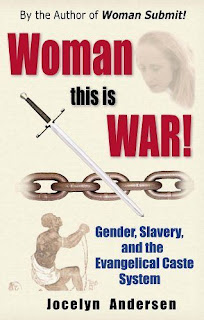
 ... Woman this is WAR! Gender, Slavery & the Evangelical Caste System: Andersen, Jocelyn: 9780979429323: Amazon.com: Books

What readers are saying:

"This book is well written, well researched, and a real eye opener."

"Andersen is a gifted writer, and the book was easy to read even as it covers thoughtful and sometimes technical information. I am glad I read it. I’ve read a great deal about women in the church and home, and it is easy to think there is nothing new to be learned or considered – but this book has a unique approach and covers aspects overlooked by others. Everything is well documented with footnotes in case you have questions or want sources."

"The author is not only a gifted writer but clearly well-studied and informed."

" I was pleased that translation bias was covered in a chapter, an issue that needs to be addressed, and one that I find quite hard to bring up with lay people or everyday believers who lack knowledge about Bible translation. We can trust our Bibles, but we also need to acknowledge that certain passages are difficult to translate and bias can come into play."

"Andersen tackles most of the primary the teachings of complementarianism with an impressive exegesis"

Woman this is WAR! Gender, Slavery & the Evangelical Caste System: Andersen, Jocelyn: 9780979429323: Amazon.com: Books

Do husbands present wives to God at the judgment?


  Husbands love your wives even as Christ also loved the church and gave Himself for it That He might sanctify and cleanse it with the washing of water by the word That He might present it to Himself a glorious church not having spot or wrinkle or any such thing but that it should be holy and without blemish [1]

Ephesians 5:25-27


[1] This verse cannot be used as a basis for male headship trinity marriage teaching, or as a command for complementarian husbands and wives to engage in a cosmic role-play portraying god-husband and church-wife. The Out-Called is sanctified by Christ and His redeeming work on the cross, His death, His burial, and His resurrection, His triumph over death.

Wives cannot be made clean and set apart by husbands who cannot redeem. Husbands will not present their wives to God at the judgment. The “He” in verses 26 and 27 refers to Jesus and not to husbands. The “Himself” referenced in verse 26, is a reference to the eternal Godhead, because Jesus is God. Jesus is the God of the BurningBush: Beloved Son Eternal Father.

1 Corinthians 7:4,14 refutes the redeemer husband fallacy by saying that the unbelieving husband is sanctified by the wife else their children would be unclean. That verse remains a puzzle to some. It also says the wife has equal authority over the husband’s body. In Christ, according to Galatians 3:29, there is equality and autonomy between all races and both sexes.

This is an excerpt of The Hungry Hearts Bible Commentary edited by this author.

 Author and speaker, Jocelyn Andersen, is an eclectic Christian writer. She is a Bible teacher who writes about many subjects including Bible prophecy and equality of the sexes. She is best known for her advocacy in domestic violence awareness. Her book, Woman Submit! Christians & Domestic Violence, has been a staple in the library of resources on that subject.  

If the topic of God and Women interests you, join the conversation HERE.

To receive an announcement from Amazon whenever a new book is released by Jocelyn Andersen, subscribe to Her Amazon author's page.

To Contact Jocelyn: Use the contact form in the sidebar of her blog at www.jocelynandersen.com to leave comments on her books, to reach her with questions, or to request for her to come and speak at your group. 


.. Woman this is WAR! Gender, Slavery & the Evangelical Caste System: Andersen, Jocelyn: 9780979429323: Amazon.com: Books

What readers are saying:

"This book is well written, well researched, and a real eye opener."

"Andersen is a gifted writer, and the book was easy to read even as it covers thoughtful and sometimes technical information. I am glad I read it. I’ve read a great deal about women in the church and home, and it is easy to think there is nothing new to be learned or considered – but this book has a unique approach and covers aspects overlooked by others. Everything is well documented with footnotes in case you have questions or want sources."

"The author is not only a gifted writer but clearly well-studied and informed."

" I was pleased that translation bias was covered in a chapter, an issue that needs to be addressed, and one that I find quite hard to bring up with lay people or everyday believers who lack knowledge about Bible translation. We can trust our Bibles, but we also need to acknowledge that certain passages are difficult to translate and bias can come into play."

"Andersen tackles most of the primary the teachings of complementarianism with an impressive exegesis"

Woman this is WAR! Gender, Slavery & the Evangelical Caste System: Andersen, Jocelyn: 9780979429323: Amazon.com: Books

The Proverbs 31 Woman: You've never seen her like this!


Commentary at end of quoted passage
   
 1: The words of king Lemuel the burden wherewith his mother corrected him 2: My son, son of my womb, son of my vows 3: Give not your strength to [whoring after] women nor your ways to that which destroys kings 4: It is not for kings O Lemuel it is not for kings to drink wine [in excess] nor for princes strong drink 5: Lest they drink and forget the law and pervert the judgment of any of the afflicted 6: Give strong drink to them who are ready to perish and wine to those that be of heavy hearts 7: Let them drink and forget their poverty and remember their misery no more 8:[But you] Open your mouth in defense of those who have no voices in the cause of all such as are appointed to destruction 9: Open your mouth judge righteously and plead the cause of the poor and needy 10: A woman of chayil, find! For her price is far above rubies 11: The heart of her lord ba`al safely trusts He shall have [no fear] of lack or plunder 12: She rewards good and not evil all the days of her life 13: She seeks wool and flax and works willingly with her hands 14: She is like the merchant's ships She brings her food from afar 15: She rises also while it is yet night and give food to her household Matthew 24:45-46 and a portion to her maidens her servants 16: She considers a field and buys it with the fruit of her hands she plants a vineyard 17: She girds her loins with strength and strengthens her arms 18: She perceives that her merchandise is good her candle goes not out by night 19: She lays her hands to the spindle and her hands hold the distaff 20: She stretches out her hands to the poor yes she reaches forth her hands to the needy 21: She is not afraid of the snow for her household for all her household are clothed with scarlet 22: She makes herself coverings of tapestry her clothing is silk and purple 23: The one who possesses her ba`al  [not husband] is known in the gates when he sits among the elders of the land 24: She makes fine linen and sells it and delivers girdles to the merchants 25: Strength and honor are her clothing and she shall rejoice in time to come 26: She opens her mouth with wisdom and in her tongue is the law of kindness 27: She looks well to the ways of her household and eats not the bread of idleness 28: Her children rise up and call her blessed the one who possesses her also and he praises her 29: Many daughters have done valiantly but you excel them all 30: Favor is deceitful and beauty is vain but a woman who fears the LORD YHWH she shall be praised 31: Give her of the fruit of her hands and let her own works praise her in the gates


Most authorities believe that name “Lemuel” was more than likely a pseudonym for King Solomon. That makes sense, as in the time of Solomon, the status of women was inferior to that of men—as it still is in all Islamic countries and among complementarian Christians, today. It would have been improper for a woman in biblical times to chastise a man—even more so if that man was her King. If this is the case, that Lemuel was Solomon, then the mother who corrected the wayward King would have been none other than the infamous **Bathsheba. 

Her words correlate perfectly with Solomon’s story, as we know that, for an unspecified length of time, after he ascended the throne, he plumbed the depths of depravity. Solomon eventually concluded that his riotous manner of living was all “vanity,” at which time he turned his life around to become the greatest King in the history of Israel and of the world in his time. Perhaps that turn-around was due to the Word of correction given to him by his mother, words that are preserved as Holy Scripture to this day. 

** We know Bathsheba had great influence with her son, as Adonijah, Solomon’s half-brother, a royal prince himself, went to Bathsheba first, when he had a request to make of his brother, the King. It is also recorded that Solomon honored his mother by having a smaller throne placed next to his royal throne for her.

That Solomon published the words of King “Lemuel’s” mother, indicates the degree of import Bathsheba's influence must have carried for him. It is entirely possible the Proverbs-31 letter could have proved the turning point in King Solomon’s life, a turn-around that can be attributed [at least in part] to the timely intervention and correction of a God-fearing mother, who dared to speak the inspired/authoritative Word of God to a son who was King.

Aside from the above comments, there are two other things of note in this passage: 1.) Whether King Lemuel was Solomon or not, in Proverbs chapter 31, we have an entire chapter of scripture written by a woman. Verse one states the passage was written to the King by the King’s mother. The fact that this passage has been included in the Hebrew scriptures along with the writings of Solomon is extraordinary—a powerful testimony to its authenticity and authority. 2.) This is an irrefutable example of a woman not only teaching a man—a very powerful man—but chastising him as well, with the inspired, prophetic, authoritative Word of the LORD. The opening words of Proverbs 31, refute complementarian positions that our Creator intended only men to be the oracles of God, and that women cannot teach men or speak the Word of God authoritatively to both men and women. King “Lemuel’s” mother did so, and continues to do so through an inspired and authoritative prophecy to a powerful male monarch, and by extension to all men and women.


Chayil H2428 means: Valor, Strength, or Might. The word never means “virtue." The Hebrew word chayil is mistranslated as “virtuous” only three times in the Hebrew text, and each of these mistranslations is deliberate due to translator bias against women (misogyny). This bias is not found in ancient translations only but also in modern translations, as translators continue to add to and take away from the Word of God with respect to the word, chayil...but only when it is associated with women. 

Other than misogyny, there is no lingual or textual reason to translate the Hebrew word, Chayil, as virtuous. The Woman of chayil, according to scripture, is a woman of strength and valor.


Taken within context of what we know about Solomon, his mother was not giving advice about how to find a wife. And though her advice is good for men in general, she was writing specifically to one man—her son—who had spent quite some time plumbing the depths of sin Ecclesiastes 1:17-18, Ecclesiastes 2:10-12, which included carousing with women and likely already had multiple wives and concubines [sex-slaves]. 

In the end, Solomon had hundreds of wives and thousands of sex-slaves. Though God says he was the wisest man who had ever lived or would ever live, with respect to women, he was not wise Deuteronomy 17:17. 

Solomon’s "concubines" were sex-slaves with a bit of status because their lord—who was not their husband—happened to be their king as well. King or not, any man with sex-slaves was the lord of those women. In fact, in Solomon's time men were lord over the women in their house-holds, whether the women were wives or sex-slaves. Bathsheba did not use the word husband for a reason. In this verse, speaking of the woman of chayil, she correctly wrote, “The heart of her "lord,” was safe with her. This terminology was correct, because Solomon was the lord of many women, most of which were sex-slaves and not wives.


Proverbs 31 has typically been used to oppress women by underscoring the alleged subordination of women to men, but this has been entirely due to misogynistic translation and interpretation. As the reader continues to read this chapter, take note that the woman of chayil is an industrious business woman. This contradicts male supremacy/complementarian doctrine that restricts the initiative of women to work outside their homes or to run their own businesses. 


The woman of chayil, adores her family without being commanded to. This is in stark contrast to fathers being commanded not to provoke their children to wrath and husbands having to be commanded to love their wives. This commentary only points that out anger and indifference in husbands and fathers (which the Bible attempts to counteract by commands to love) result directly from male-headship [complementarian theology] and traditional-role-religion.

The woman of chayil, is industrious when it comes to her home, and she has a diverse portfolio of prosperous businesses as well. She is successful in real estate, agriculture, manufacturing, and marketing. There is no mention that she is required to procure anyone's permission to start or carry out her businesses. 

The woman of chayil [Bathsheba writes of], is materially well off, if not extremely wealthy. She has servants who do most of the physical labor for her. Her family does not suffer from neglect, because she has excellent organizational skills in seeing to the material and physical comfort of her household. 

This correlates perfectly with New Testament scripture that commands women to rule the home. Here we see another deliberate, misogynistic, mistranslation that reduces “rule” to “guide.” The Greek word oikodespoteo, is mistranslated as “guide” in 1 Timothy 5:14. It means home-ruler or home despot [dictator, but not in a bad way]). 

New Testament wives are commanded to not just guide their households, but to rule them. The woman of chayil rules her home well. In this and other passages, God's original purpose for one wife per husband is strongly insinuated--one wife to rule one home--not multiple wives and sex-slaves per each man. 

The woman of chayil, is also a respected admired business-woman. She is admired and respected socially and by civic leaders, in her own right and not as simply an extension of her husband. She enjoys the praise and support of her husband and children, who stand solidly behind her in all her endeavors. Her family benefits both materially, socially, and politically from her business success and good reputation as a woman of strength and good character. 


Men who bury the treasure [of women of chayil] in pits of subordination—or lock them in prisons of male supremacy—bury their strength. And, to some degree or other, bring upon themselves and their families shame and lack. They become like those described in The Revelation who say they are rich but are really poor and don’t even know it.

Women of chayil have survived such circumstances for millennia  and have honorably managed very well. These incredible women are to be saluted. But there is a vast difference between surviving and thriving. Many survive, but no one thrives under male headship. And, unless there is repentance and change, no one's--not women's or men's--full potential can never be reached.


 Author and speaker, Jocelyn Andersen, is an eclectic Christian writer. She is a Bible teacher who writes about many subjects including Bible prophecy and equality of the sexes. She is best known for her advocacy in domestic violence awareness. Her book, Woman Submit! Christians & Domestic Violence
, has been a staple in the library of resources on that subject.  

If the topic of God and Women interests you, join the conversation HERE.

To receive an announcement from Amazon whenever a new book is released by Jocelyn Andersen, subscribe to Her Amazon author's page.