Showing posts with label Slavery. Show all posts

1 Peter 3:1 Does not mandate female subordination or male headship


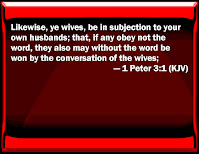
 Likewise the women yield to your own men that if any obey not the word they also may without The Word be won by the behavior of the wives [1]


[1] In 1 Peter 3:1, is the writer telling wives that they are basically slaves and should emulate the subjective behavior of slaves as instructed in 1 Peter 2:18? 

This writer does not believe so. Hebrew and Greek scholar, Bruce Fleming, does not believe so either. Fleming teaches that 1 Peter 3:1 is not connected at all with 1 Peter 2:18-25 but rather an entirely new subject. He speaks about this in season four of his Eden Podcast, and he makes some very good points.

Fleming’s interpretation is possible. But regardless, this writer believes there is no doubt [that in the mind of the biblical writer] 1 Peter 3:1 is a continuation of the subject introduced in the last eight verses of 1 Peter 2 [:18-25] about slaves enduring unjust harshness and violence from masters. Without chapter and verse breaks [which is how the Bible was originally written], the passage is clearly one unbroken conversation about one topic, that of slaves being subject to masters and the writer leads seamlessly into the subject of women subjecting themselves to men: QUOTE “Slaves [be] subject to [your] masters with all fear not only to the good and gentle but also to the froward For this [is] thankworthy if one for conscience toward God endure grief suffering wrongfully For what glory [is it] if when you be beaten for your faults you shall take it patiently But if when you do well and suffer [for it] you take it patiently this [is] acceptable with God For even to this were you called we are all called to this because Christ also suffered for us leaving us an example that you should follow his steps Who did no sin neither was guile found in his mouth Who when he was reviled, reviled not again When He suffered he threatened not but committed [himself] to Him that judges righteously Who his own self bare our sins in his own body on the tree that we being dead to sins should live to righteousness by whose stripes you were healed For you were as sheep going astray but are now returned to the Shepherd and Bishop of your souls Likewise women …[be] in subjection to your own men that if any obey not the Word they also may without the Word be won by the behavior of the women.” END QUOTE

Peter certainly made a seamless connection when writing about the subjection of slaves to masters and the subjection of women to their men. This is confirmed in 1 Peter 3:5-6 where he wrote that Sara called Abraham master. Nowhere do we read in scripture where Sarah called Abraham master, so this statement must be taken from the Jewish extra-scriptural writings. These writings are commentary and not inspired scripture, but Peter was obviously familiar with them.

19th Century Greek and Hebrew scholar, Katherine Bushnell did not believe women are scripturally commanded to subject themselves to male dominance on any level. But she also believed that 1 Peter 3:1 was connected with 1 Peter 2:18 and she had this to say about it she began with the Hebrew and then show how the Greek [in 1 Peter] connected with it: QUOTE “The Old Testament sense in which "to be in subjection" is sometimes used, is highly suggestive and instructive. Psalm 62:1 reads in the English, "truly my soul waits upon God; from Him cometh my salvation.” At verse 5 of the same Psalm, we read: "My soul, wait thou only upon God.” In Psalm 37:7 we find the words: "Rest in the Lord and wait patiently for Him.” The words "wait" in the first passages, and the word "rest" in the last are all three represented in the Greek version by the single word hupotasso, "be in subjection," while the literal sense of the Hebrew original word is "be silent unto.” Compare this with 1 Peter 3:1,2, where wives are exhorted to win unbelieving husbands by "subjection.” Surely Peter is not here exhorting wives to blindly obey unbelievers, for if heathen, they would at once remand them back to the worship of the gods; if Jews, back to Judaism. Rather, they are to win them away from these by their "manner of life,” “without The Word,"--actions speaking louder than words. "Coupled with fear,"—such fear of God as would cause these women, so gentle, quiet, and patient in daily life, to be as adamant in their truth to God; and the husbands so overawed by their quiet maintenance of principle, whereas they are so ready to yield to their husbands when principle is not involved, that the husbands dare not try to compel their wives to violate conscience, and thus are themselves gradually led into the Christian faith. Where “subjection” is spoken of as a woman’s duty, without further immediate specification, it has been too readily assumed that this means subjection to a husband. But many women even from Apostolic days, and certainly an increasing large proportion of women in latter days, have no husbands. In both 1 Corinthians 14:34, “let them be in subjection”; and in 1 Timothy 2:11, “learn in all subjection,” this O. T. idea of waiting on God, or the thought of a spirit of humility towards God, may be all that is intended.” END QUOTE


Another View

The biblical writer’s direction to slaves and women were not biblical condonements of institutionalized slavery or systemically-mandated female subjection to males, but this writer believes the instruction found 1 peter 2:18 and 1 Peter 3:1 stem from concern for the safety of both.

It was taught then that all Christians [slaves, women, and men] were spiritually free in Christ, and all Christians [then and now] are equal Galatians 3:28,1 Peter 5:5, but depending on geographic location and local and national laws, all were, and are, not entitled to the same legal autonomy. While earth-bound, Roman slaves and women were still confined by oppressive laws and cultural expectations. That is still the case in many parts of the world today. 1 Peter 2 & 3 was both instruction and encouragement that a godly lifestyle in freely subjecting oneself to an unfortunate legally-mandated lot would not only *keep slaves safer but also was not un-noticed by God and would not go unrewarded. Women were higher on the social and legal scales than slaves, but their autonomy was still greatly restricted, and they were maliciously written about by philosophers, playwrights, and poets of the day. Though enjoying more legal protections, by the first century, domestic violence was still a very real part of Roman and Jewish life and first century Christian women were certainly at risk.

*Throughout Roman history, slaves could be killed at will by masters with no repercussion. By the time of Christ, manus marriage, which entitled Roman husbands to arbitrarily kill wives was replaced by sine manu marriage, whereby married women remained under the protection of their pater-families or of a male guardian appointed by their pater-families. This made the murder wives [with little to no legal or social repercussion] much more difficult. But domestic violence and abuse was another subject altogether. The Romans from Augustus on, liked to appear fair and gentle in public by passing some very good laws favoring women, but one Greek/Roman historian lamented that literary writings on the subject of domestic abuse and domestic violence [in the late republic] is frustratingly quiet. In other words, domestic abuse was winked at and swept under the rug.

Domestic violence and abuse are a given in any society that considers women as inferior or lesser than men. Virtually all the Church Fathers, considered women inferior and dangerous if given autonomy. They repeat this often in their writings. These same Church Fathers continue to be studied extensively today, as they should but with their anti-women rhetoric refuted in Christian seminaries, but it is not. It is simply ignored.

Gender-bias in Bible translation is rampant and creates a perceived scripture-bias against women where none exists. Holy Spirit inspired biblical writers do not exhibit such bias, but this is difficult to see when modern translators insist on holding to historical and traditional attitudes that are harmful to women. Even today, with progressive laws, three women a day [in the United States] die from domestic violence. A Methodist survey done in the 1970’s, found that one in six Christian women experienced violence at the hands of husbands or boyfriends. Domestic violence among professing Christians is just as rampant as among unbelievers. Why would anyone assume that First Century women were not at even greater risk when misogyny was the systemically legal order of the day and the norm for their culture?

Cultures exist today, where Christians are both legally enslaved and women are literally slaves of their husbands. Many of these women must hide their faith in Christ. They would not in any case be able to speak of Christ or share his Word with their husbands, who are literally and legally their masters. Many have zero legal recourse against abuse or potentially deadly domestic violence. They must, of necessity endure the harshness and danger, with seemingly no hope of escape. Just as 1 Peter 2:18 is not a message to Christian slaves that institutionalized slavery is God’s will, 1 Peter 3:2 is not a message to Christian women that God created them as inferiors to men or that it is his will for them tolerate violence and abuse. It was a message intended to protect [as much as possible] and encourage slaves and at-risk women of every era


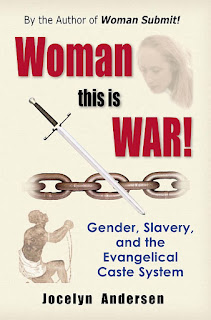
... Woman this is WAR! Gender, Slavery & the Evangelical Caste System: Andersen, Jocelyn: 9780979429323: Amazon.com: Books

What readers are saying:

"This book is well written, well researched, and a real eye opener."

"Andersen is a gifted writer, and the book was easy to read even as it covers thoughtful and sometimes technical information. I am glad I read it. I’ve read a great deal about women in the church and home, and it is easy to think there is nothing new to be learned or considered – but this book has a unique approach and covers aspects overlooked by others. Everything is well documented with footnotes in case you have questions or want sources."

"The author is not only a gifted writer but clearly well-studied and informed."

" I was pleased that translation bias was covered in a chapter, an issue that needs to be addressed, and one that I find quite hard to bring up with lay people or everyday believers who lack knowledge about Bible translation. We can trust our Bibles, but we also need to acknowledge that certain passages are difficult to translate and bias can come into play."

"Andersen tackles most of the primary the teachings of complementarianism with an impressive exegesis"


 Author and speaker, Jocelyn Andersen, is an eclectic Christian writer. She is a Bible teacher who writes about many subjects including Bible prophecy and equality of the sexes. She is best known for her advocacy in domestic violence awareness. Her book, Woman Submit! Christians & Domestic Violence, has been a staple in the library of resources on that subject.  

If the topic of God and Women interests you, join the conversation HERE.

To receive an announcement from Amazon whenever a new book is released by Jocelyn Andersen, subscribe to Her Amazon author's page.

To Contact Jocelyn: Use the contact form in the sidebar of her blog at www.jocelynandersen.com to leave comments on her books, to reach her with questions, or to request for her to come and speak at your group. 

First century wives and slaves: No legal recourse for either


 5: Slaves obey lords according to the flesh with fear  and trembling[1] in singleness of your hearts as [to] Christ

Ephesians 6:5


[1] The apostle meant what he said to Christian slaves about fear and trembling before their masters. Slaves were considered sub-human, and Roman Lords could do anything they liked with their slaves. They could harm or kill them in any manner they chose. Paul was not condoning slavery when he wrote this but rather was intent on the physical safety of those in his congregations who were slaves.

The standing of women in Roman society [and in Jewish tradition] was only slightly higher than that of slaves. Women were honored and respected in the Hebrew scriptures, but not in the Tradition’s. Jesus had nothing good to say about the Traditions, so Paul would have been concerned for the physical safety of the wives in his congregations as well, hence his warning for wives to fear their husbands.

Christian women of the first century experienced an equality of the sexes almost unheard of in all of history [before and after that era]. This liberty would certainly pose a physical threat to wives of violent controlling husbands. Such men would not tolerate wives who dared to exhibit personal autonomy. This liberty among early Christians would naturally have the effect of escalating tension. Violence would have increased in such marriages. 

One shudders to think what the domestic violence mortality rate of first century women must have been. The apostle knew this. He also knew there was no [or limited] legal recourse in cases of violence against women, as “domestic violence” was not part of first century legal jargon.

This is an excerpt from The Hungry Hearts Bible Commentary edited by this author.


 ... 
Woman this is WAR! Gender, Slavery & the Evangelical Caste System: Andersen, Jocelyn: 9780979429323: Amazon.com: Books

What readers are saying:

"This book is well written, well researched, and a real eye opener."

"Andersen is a gifted writer, and the book was easy to read even as it covers thoughtful and sometimes technical information. I am glad I read it. I’ve read a great deal about women in the church and home, and it is easy to think there is nothing new to be learned or considered – but this book has a unique approach and covers aspects overlooked by others. Everything is well documented with footnotes in case you have questions or want sources."

"The author is not only a gifted writer but clearly well-studied and informed."

" I was pleased that translation bias was covered in a chapter, an issue that needs to be addressed, and one that I find quite hard to bring up with lay people or everyday believers who lack knowledge about Bible translation. We can trust our Bibles, but we also need to acknowledge that certain passages are difficult to translate and bias can come into play."

"Andersen tackles most of the primary the teachings of complementarianism with an impressive exegesis"

Woman this is WAR! Gender, Slavery & the Evangelical Caste System: Andersen, Jocelyn: 9780979429323: Amazon.com: Books


 Author and speaker, Jocelyn Andersen, is an eclectic Christian writer. She is a Bible teacher who writes about many subjects including Bible prophecy and equality of the sexes. She is best known for her advocacy in domestic violence awareness. Her book, Woman Submit! Christians & Domestic Violence, has been a staple in the library of resources on that subject.  

If the topic of God and Women interests you, join the conversation HERE.

To receive an announcement from Amazon whenever a new book is released by Jocelyn Andersen, subscribe to Her Amazon author's page.

To Contact Jocelyn: Use the contact form in the sidebar of her blog at www.jocelynandersen.com to leave comments on her books, to reach her with questions, or to request for her to come and speak at your group. 

Review of Lydia's Song: A Child Lost A Woman Found

  ...I did not want to read this book. I cringed at the subject matter. But I am so glad I overcame my initial reluctance and read it anyway. Katherine Blessan does not pull any punches. She dealt with the horror and tragedy of child sex trafficking head-on, yet somehow managed to craft a compelling story, that is ultimately a redemptive story of hope.

I loved it.

The book is about a tiny girl named "Song," who was kidnapped from her adoptive mother, Lydia, and sold into the sex trade at age ten.The story is told from both Song's point of view and Lydia's. It is a well written and sensitive depiction of a dark underbelly that exists in most societies, what is being done to little girls like Song, and also about the people who risk and dedicate their lives to rescuing these precious children, and, after that, spend years helping them to recover from their experiences and reintegrate back into society.

The novel is a bit graphic in places, but I believe no more than necessary, and my hat is off to Blessan for having the courage to write faithfully. I strongly recommend this book. Everyone needs to read it. I pray Lydia's Song will be read and shared and read and shared and read and...

And that eyes and hearts will be opened to the plight of girls who desperately need us to care enough to step out of our comfort zones and at least read about them. And after that, to hopefully become voices against their enslavement and for their rescue. 

Lydia's Song: The Story of a Child Lost and a Woman Found by Katherine Blessan (19-Sep-2014) Paperback: Amazon.com: Books


Subscribe to Jocelyn’s Updates & Newsletters: http://eepurl.com/dgDt6b


Interview with Jocelyn About her Book "Woman this is WAR!"


What is Woman this is War! about? It is about change. In many churches and homes, women are treated as second class citizens. This is not only unchristian and unbiblical, but it is unhealthy. It is emotionally and spiritually detrimental to all involved, and sometimes physically dangerous to women and girls.
   Can you elaborate on that statement? Yes. How can it be healthy and beneficial when Christian leaders call men who love their families but have no desire to rule over their wives, "wimps," and when prejudice against women is encouraged as Christians are taught that the underlying motive in the heart of every woman is to dominate men? This is taught by the Council for Biblical Manhood and Womanhood [CBMW] and is posted on their website. 
   Additionally, studies show that aggression and violence against girls and young women is increasing among young boys and college age young men. This has been connected with strongly held gender role beliefs. Tragically, mainstream Christianity is the primary propagator of this harmful paradigm. Complementarian teachings, pit husbands and wives against each other and often interfere in what might otherwise be happy marriages. Female submission teaching creates problems that complementarian leaders promise to solve. Thus, a thriving industry has been created for complementarian authors, speakers, and conference organizers that generates millions of dollars for those claiming to solve the very issues that their doctrine creates. 
   You sound like a feminist; isn't feminism opposed to Christianity and Biblical teaching? The definition of feminism has evolved over the years but at its most basic is simply "advocating for social and political equality for women." There is nothing inherently evil about that. 
   Language plays a dominant part in defining cultural attitudes. The earliest definitions of the word "feminist" were drafted by men in the 1930's. These men were hostile to the idea of equality between women and men. Webster's Dictionary first defined feminism as "propaganda," "the 'cult' of advocating for social and political equality for women." 
From 1938: The word "Feminist" was not yet in dictionary


   It is the original smear on the idea of equality, embodied in the first definitions of the word "feminism" and then later the word "feminist," that lies at the root of the negativism and stigma still attached to the word today.  
   The current practice within mainstream Christianity, is to label all manner of evil as "The Feminist” agenda. 
   Additionally, there is no evidence that Biblical feminism is a spin-off of secular feminism. It cannot be connected with secular feminism in any way. I document this thoroughly in my book, and anti-feminist author, Mary Kassian, admits as much in her book. 
   It is sad that Christian historians and authors have ignored, and even grossly misrepresented, significant Christian initiatives in the many movements for the autonomy of women. 
   Christian women and men have been instigators in the various historical movements for women's rights from the very beginning. For instance, four of the five women who organized the Seneca Falls Woman's Rights Convention in 1848, were Quakers. Christian involvement in women's rights spans oceans and continents and can be traced to the 17th century. The very first feminist is said to be a Christian. I write about her in my book. 
   Christian women and men have a rich heritage in advocating for equality of the sexes; and it is a heritage we should be proud of. 
   What about women in the Church? The teaching that men should lead and women should follow cannot be found in scripture. In fact, there are scriptural examples of both women and men and of men following women. The complementarian prohibition against women teaching or leading in either the Old Testament or the New has no scripture to stand on. In Woman this is WAR!, I cover this in detail. It is a complete theological treatise on the subject of complementarianism and equality. 
   This is a contentious subject. Shouldn’t women just drop it and yield to male leadership for the sake of peace and order? No. Only true equality—in both essence and function—promotes true peace. In God’s order, liberty and autonomy are not gender-based and is commanded for all of his human creation. Insisting on gender-based hierarchy is unbiblical and sinful. No Christian should yield to sin. If refusing to submit to sin disturbs the peace, the fault lies with those exhibiting the sinful behavior—not by those refusing to submit to it. 
   Regarding women, your title accuses the church of aligning itself with caste and slavery. How can this be justified? It is justified, because it is true. Mainstream Christianity has historically taught [and currently teaches] that women are born into subordination for the simple fact that they are female. Complementarianism teaches that there is nothing a woman can do to rise above the fact of her birth. This is caste. Many of the arguments used to keep women in subjection are identical to the arguments used by slaveholders in attempts to prove that God divinely mandated slavery. I once spoke with a young complementarian who still believes that God mandated chattel slavery! In the book, I draw many parallels between the attitudes of 19th century slaveholders and those of 21st century traditional role religionists and complementarians. 
   It sounds like you cover a great deal of historical background in your book: Yes, Woman this is WAR! is a treasure trove of historical information relevant to the contemporary issue of complementarianism and should be of interest to anyone researching not only the Christian aspects of historical women's rights movements but also Black History. Some prominent figures in the movement for women's rights were former slaves. Also, many African Americans who played prominent parts in facilitating freedoms we enjoy today were devout Christians. I write about these in Woman this is WAR! 
 How would this book benefit non-Christians? The historical aspects, of course. But also, the issues exposed in Woman this is WAR! do not affect just Christians. Religious misogyny (not just Christian) held by judges, politicians, employers, teachers, and others demands to be expressed, and it does so in court case rulings, legislative voting, when hiring and doling out job raises and promotions, and with treatment of students. Although this book does not deal with these particular areas [or other religions besides Christianity] in detail, it is a fact that regardless of religion, the sacred beliefs of people in authority or positions of influence, can pose a danger to human rights [most especially the human rights of women] due to strongly held convictions about gender roles. We see this in all three of the main world religions: Judaism, Christianity, and Islam. In order to understand how this can be true, this is the book to read and recommend.

If the topic of God and Women interests you, join the conversation HERE.

Margaret Fell: A Woman with an "Agenda"


 In honor of Women's History Month, the following is an excerpt from my book, Woman this is WAR! Gender, Slavery and the Evangelical Caste System:

Margaret Fell
Margaret Fell lived in the Seventeenth Century and is credited with being the first feminist. Her cause? The right of women to preach the Gospel.

Co-founder of the Society of Friends, the Quakers and called the Mother of Quakerism [1], Fell is credited with being the first woman to publicly advocate for the right of women to participate in the public arena and to be involved in the leadership of the church. 

In 1666, she became the first woman to publish a fully developed treatise on the right of women to speak publicly.[2] Her argument was compelling and based entirely on scripture. There is no record that during the course of pursuing her “agenda” of helping to establish the Society of Friends and the equal rights for women promoted within that society, that Fell ever abandoned her faith in the God of Abraham, Isaac, and Jacob, or forsook her family to embrace an immoral lifestyle. Fell’s husband, Judge Thomas Fell, trusted her entirely with the running of their estate while he traveled extensively in the course of carrying out his duties. 

The Society of Friends acknowledged the practical equality of all people from their inception. Although it took them a while to learn how to implement the concept, they finally succeeded, and as a result, many “Friends,” both men and women, became involved in the early movements for abolition of slavery and women’s rights.

The first national Woman’s Rights Conference was organized primarily by women who had already gained experience in public speaking, administration, and organizational skills through their activities in Quaker meetings. As the first woman to speak publicly in the United States was not permitted to do so until 1836, the providence of God is evident in preparing Quaker women for public speaking and in providing them with opportunities to gain the organizational experience needed for furthering the causes of abolition and women’s rights. 

 The first American “Woman’s Rights” Conference held in Seneca Falls, New York, in 1848, was a largely Christian event. It was held at a Methodist Church. Most of the organizers were Quakers, and the majority of attendees were professing Christians.

Margaret Fell advocated not only for freedom of conscience in worship and religious matters, for which she was imprisoned on more than one occasion, but also for the right of women to preach the gospel, teach the Bible, and participate in the affairs of the church on an equal basis with men. No one who reads her writings can doubt her high esteem for God and his Word, the Bible.

Jesus said, “Wherefore by their fruits ye shall know them.” What are the fruits of Margaret Fell’s labors? Following Fell’s example in the seventeenth century, history records that in the centuries to come, the voices of “Friends” are heard speaking out against societal injustice and were instrumental in effecting many changes that to this day benefit children, women, and men.

According to Angelina Grimke, an abolitionist and member of The Society of Friends herself, the very first Quaker voice raised against slavery [in the United States] was the voice of an American woman who lived during the 1700’s. Because of her outspoken stance against slavery--before it was acceptable or popular to do so--this courageous woman was excommunicated from her Quaker fellowship but stood her ground until her death.[3] She made such an impact, that after her death, the Quakers never again excommunicated another "Friend" for speaking out against slavery...but rather for owning slaves.

Such is the legacy of Godly women who dared to stand against false religious tradition and corrupt public opinion.


[1] The Society of Friends is known more commonly as the Quakers
[2] Women's Speaking Justified, Proved and Allowed of by the Scriptures, All Such as Speak by the Spirit and Power of the Lord Jesus And How Women Were the First That Preached the Tidings of the Resurrection of Jesus, and Were Sent by Christ's Own Command Before He Ascended to the Father (John 20:17), by Margaret Fell, 1666
[3] “They know that the first Quaker who bore a faithful testimony against the sin of slavery was cut off from religious fellowship with that society. That Quaker was a woman.” Angelina Emily Grimke, An Appeal to the Christian Women of the South, 1836


  ...  Woman this is WAR! Gender, Slavery & the Evangelical Caste System: Andersen, Jocelyn: 9780979429323: Amazon.com: Books   This work provides valuable historical insight into Christian initiatives in the movements for women’s rights, that are rarely included in Christian literature.

Subscribe to Jocelyn’s Updates & Newsletters: http://eepurl.com/dgDt6b


 Jocelyn Andersen writes and speaks about many subjects including Bible prophecy and equality of the sexes. She is best known for her advocacy in domestic violence awareness. Her book, Woman Submit! Christians & Domestic Violence, is a staple in the library of resources on that subject.  

If the topic of God and Women interests you, join the conversation HERE.

To receive an announcement from Amazon whenever a new book is released by Jocelyn Andersen, subscribe to Her Amazon author's page.

To Contact Jocelyn: Use the contact form in the sidebar of her blog at www.jocelynandersen.com to leave comments on her books, to reach her with questions, or to request for her to come and speak at your group.