Showing posts sorted by relevance for query domestic violence. Sort by date Show all posts

Misunderstandings about domestic abuse & domestic violence


Domestic abuse and domestic violence are rare. FALSE. According to the department of Justice. Three of every 100 American households is affected by domestic violence. 

According to the National Census Bureau, 3 of every 100 households adds up to approximately 37,000,000 Americans, primarily women, who are experiencing domestic violence or abuse.

What is domestic abuse? Simply put, domestic abuse is warfare. It turns the home, which should be a sanctuary of peace and safety into a battlefield filled with destruction and misery--with the abuser waging psychological warfare, and sometimes physical warfare, against his or her victim(s).

Only women are victims of domestic abuse and/or violence. FALSE. Department of Justice figures show that men comprise 5% of domestic violence murder victims.

Studies prove that women violently abuse just as much or more than men do. FALSE. Department of justice statistics do not back those studies. As one supporter of those studies succinctly put it, "With a U.S. population of 297 million, it's possible to cherry-pick a small, non-representative, sample to prove nearly anything."

Substance abuse is a major cause of domestic violence. FALSE. Treatment for substance abuse will not cure domestic abuse or violence. Although substance abuse is often used as an excuse for domestic violence and can certainly exacerbate and intensify incidences of abuse (and substance abusers do need to address the issue), it is not the cause of domestic abuse or domestic violence. Abuse and domestic violence are inflicted on victims by those who have an excessive need for control. In the case of men against women, the root cause of abuse often stems from a deeply rooted sense of male superiority over women. 

Anger management will prevent abusive behavior. FALSE. Anger management will not cure abusive behavior, because anger is not the root cause of spousal abuse or domestic violence. Although controlling anger is always helpful, it will not prevent recurrences of abuse if the core values of the abuser are not challenged and changed.

Submitting to the demands of an abuser will stop or prevent abuse. FALSE. Studies have shown that the more submissive a victim is, the more likely the abuser is to continue and even increase the abuse. It is not recommended, however, to directly challenge a violent abuser.

Finding a good couple's counselor will help resolve abuse issues in a relationship. FALSE. Couple's counseling will not prevent abuse. Abuse is a personal issue as well as a choice on the part of the abuser. Although abuse will cause problems in a relationship, abuse and/or domestic violence does not stem from problems within the relationship. When it comes to domestic abuse or domestic violence, the saying, “It Takes Two to Tango,” does not apply. One of the reasons couple's counseling is not recommended in the case of domestic violence, is that it increases the risk of physical violence and potential harm to the victim.


 The book, Woman Submit! Christians & Domestic Violence, is available free with Kindle Unlimited. Gifting print copies to  spiritual leaders and shelters is a great way to participate in Domestic Violence Awareness month in October. But why wait for October when three women will die today from DV, and another three tomorrow, and another three....   

We Just Lost Ground


I am outraged that Kansas would repeal laws to protect women from aggravated assault at the hands of husbands and boyfriends. Women have fought so long and hard to make what progress we have only to hear that now we are not worth the money it takes to protects us from violence?

In case any of you have not heard, the Shawnee County District Attorney decided last month that he would no longer prosecute domestic violence cases in the city of Topeka. Outraged at the power play by the D.A.—not the threat to the safety of women—the Topeka City Council voted to reduce felony domestic violence cases to “misdemeanor domestic abuse.” They promptly released eighteen offenders without pressing any charges.

This was an issue of power and money between the Topeka City Council and the Shawnee County District Attorney. Women there are considered nothing more than pawns to be sacrificed on the altars of power and money.

We need three things. First, we need an Equal Rights Amendment. What happened in Topeka can happen again and again in one city after another until women are reduced to the lack of protection we experienced 50 years ago. Don’t say it can’t happen. It just happened in Kansas! An Equal Rights Amendment is the only thing that cannot be changed by a City Council or a simple congressional vote.

Second, Women need to be declared victims of hate crimes. Hate Crime is a legal category used to describe bias motivated violence. Violence against women, especially when perpetrated by a spouse or boyfriend, should be categorized as a hate crime. In most domestic violence cases, women are assaulted because they are women. That makes domestic violence a hate crime.

Hate crime laws enhance penalties associated with conduct that is already criminal under other laws. Conversely, domestic violence laws, by virtue of the language itself, often have the effect of minimizing the severity of criminal conduct in the minds of the prosecutors—as the Shawnee D.A. just demonstrated!

But whether or not the crime was committed because of a generalized sense of male privilege or entitlement or because of a religiously motivated hatred of women due to deeply held complementarian beliefs, what happened in Topeka underscores the need for women to be declared victims of hate crimes as well as the need for an Equal Rights Amendment which would do far more to protect women than local laws which, as demonstrated in Topeka, are easily repealed.

Third, the term “domestic violence” needs to be purged from our legal vocabularies. There is nothing domestic about violence, and such language used to describe violence against women minimizes the severity of the violence in the minds of those who hear such watered-down verbiage. A crowbar does less damage when it’s wielded by a husband or boyfriend and smashes into the face of a woman? Aggravated assault is aggravated assault!

There has been an appalling apathy concerning getting the Equal Rights Amendment ratified. I hope what happened in Topeka will serve as a wake-up call to us all. Women need Constitutional protection.


Author and speaker, Jocelyn Andersen, is an eclectic Christian writer. She is a Bible teacher who writes about many subjects including Bible prophecy and equality of the sexes. She is best known for her advocacy in domestic violence awareness. Her book, Woman Submit! Christians & Domestic Violence, has been a staple in the library of resources on that subject.  

To receive an announcement from Amazon whenever a new book is released by Jocelyn Andersen, subscribe to Her Amazon author's page.

To Contact Jocelyn: Use the contact form in the sidebar of her blog at www.jocelynandersen.com to leave comments on her books, to reach her with questions, or to request for her to  speak at your group. 


Getting Involved as Domestic Violence Services Fall Victim to Budget Cuts

Funding for domestic violence programs and services are decreasing in some states. 

These services are vital but do not absolve Christians from providing biblical, knowledgeable, and compassionate support to victims of abuse. 

It is wrong to depend solely on local and state services to help those within our spheres of influence. 

For many, like former pastor's wife, Susan Greenfield, author of, Would the Real Church PLEASE Stand Up!, domestic violence shelters and services play a vital part in her escape and were all she and her children had to turn to. Domestic violence counselors, instead of her "church family," were her only supporters as she navigated the terrifying minefield of domestic abuse. 


Let that sink in.

Christians, we must step up to the plate, and stop refusing to get involved in these horrendous situations. It is time to get out of our comfort zones. Lives may depend may on it. 

Know the local resources in your areas. Program them into your phones. Be ready to refer to them. Often that is the only safe solution. But what if there are no services in your area? What if there is no room in a facility for the one asking you for help?  

What is your church or group doing to gain understanding of the facts and dynamics of abusive and even violent relationships? Don't tell her to "just leave," and then turn your back on her. Yes it's frustrating. Yes it's frightening. But the Word of God commands us bear one another's burdens, and battered women who come to us for help, don't need to be sluffed off to the "professionals." Referrals and sluffing-off are two completely different things. Learn the difference.

Abused Christian women come to Christian friends, family, and spiritual leaders for godly counsel and emotional support. Are you prepared to give it? Are you prepared to put hands and feet to your prayers and advice? Does your group or church have a benevolence fund that includes helping battered women and their children? It should. 

Every month, not just October, should be domestic violence awareness month. As this is being written there are 17-days before domestic violence awareness month begins. In that 17-days, 51 women will die from a homicidal incident of domestic violence. And that does not count the number of children who die as part of these same homicidal incidences by the fathers, stepfathers, and boyfriends who murder the mothers.

It is time to learn how to respond biblically, knowledgeably, and compassionately to someone who may turn to you for help. My book, Woman Submit! Christians & Domestic Violence, is a good place to start. It is available on Kindle Unlimited, and you can read the first chapter free at womansubmit.com.

 Author and speaker, Jocelyn Andersen, is an eclectic Christian writer. She is a Bible teacher who writes about many subjects including Bible prophecy and equality of the sexes. She is best known for her advocacy in domestic violence awareness. Her book, Woman Submit! Christians & Domestic Violence, has been a staple in the library of resources on that subject.  

To receive Jocelyn's newsletters, subscribe HERE.

To receive an announcement from Amazon whenever a new book is released by Jocelyn Andersen, subscribe to Her Amazon author's page.

To Contact Jocelyn: Use the contact form in the sidebar of her blog at www.jocelynandersen.com to leave comments on her books, to reach her with questions, or to request for her to come and speak at your group.


Myth-Understandings about Domesic Violence

 Press Release:  October is Domestic Violence Awareness Month. Between Today (August 6, 2021) and October first, 165 women will die from spousal or partner abuse. Is your group or organization prepared to respond knowledgeably and compassionately if someone experiencing domestic violence or abuse comes to you for help?

Before turning to law enforcement for help, most women will first turn to friends, family, or clergy. Jocelyn Andersen, of Central Florida, is a survivor of domestic violence and the author of the book, Woman Submit! Christians& Domestic Violence. She is available to speak to your church, group, or organization on the subject of "Myth-understandings about Domestic Violence" and how we can advise and assist those who turn to us for help. 


 Author and speaker, Jocelyn Andersen, is an eclectic Christian writer. She is a Bible teacher who writes about many subjects including Bible prophecy and equality of the sexes. She is best known for her advocacy in domestic violence awareness. Her book, Woman Submit! Christians & Domestic Violence, has been a staple in the library of resources on that subject.  

To receive Jocelyn's newsletters, subscribe HERE.

To receive an announcement from Amazon whenever a new book is released by Jocelyn Andersen, subscribe to Her Amazon author's page.

To Contact Jocelyn: Use the contact form in the sidebar of her blog at www.jocelynandersen.com to leave comments on her books, to reach her with questions, or to request for her to come and speak at your group. 


Evangelical leaders endanger victims of domestic violence

I stand by what I said in a public interview 14 years ago. It is a sad commentary that secular groups see it as their goal to educate Christians on how to respond knowledgeably and compassionately to victims of domestic violence, when it should be the other way around. Christians should be leading the charge on ending domestic violence and abuse. But they are not. Some progress is being made, but we still have a long way to go. 

Quote from interview: "Andersen says, 'Secular organizations are constantly addressing the religious aspects of domestic violence. Christian women struggle with it and the secular organizations see what Christian women go through and religious women go through. They have set it up as their goal to educate spiritual leaders on the spiritual aspects, and the different aspects of domestic violence so they can give good counsel to the women coming to them. It's a big issue.'" End Quote


 Author and speaker, Jocelyn Andersen, is an eclectic Christian writer. She is a Bible teacher who writes about many subjects including Bible prophecy and equality of the sexes. She is best known for her advocacy in domestic violence awareness. Her book, Woman Submit! Christians & Domestic Violence, has been a staple in the library of resources on that subject 

To receive Jocelyn's newsletters, subscribe HERE.

To receive an announcement from Amazon whenever a new book is released by Jocelyn Andersen, subscribe to Her Amazon author's page.

To Contact Jocelyn: Use the contact form in the sidebar of her blog at www.jocelynandersen.com to leave comments on her books, to reach her with questions, or to request for her to come and speak at your group.


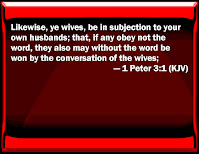
1 Peter 3:1 Does not mandate female subordination or male headship


 Likewise the women yield to your own men that if any obey not the word they also may without The Word be won by the behavior of the wives [1]


[1] In 1 Peter 3:1, is the writer telling wives that they are basically slaves and should emulate the subjective behavior of slaves as instructed in 1 Peter 2:18? 

This writer does not believe so. Hebrew and Greek scholar, Bruce Fleming, does not believe so either. Fleming teaches that 1 Peter 3:1 is not connected at all with 1 Peter 2:18-25 but rather an entirely new subject. He speaks about this in season four of his Eden Podcast, and he makes some very good points.

Fleming’s interpretation is possible. But regardless, this writer believes there is no doubt [that in the mind of the biblical writer] 1 Peter 3:1 is a continuation of the subject introduced in the last eight verses of 1 Peter 2 [:18-25] about slaves enduring unjust harshness and violence from masters. Without chapter and verse breaks [which is how the Bible was originally written], the passage is clearly one unbroken conversation about one topic, that of slaves being subject to masters and the writer leads seamlessly into the subject of women subjecting themselves to men: QUOTE “Slaves [be] subject to [your] masters with all fear not only to the good and gentle but also to the froward For this [is] thankworthy if one for conscience toward God endure grief suffering wrongfully For what glory [is it] if when you be beaten for your faults you shall take it patiently But if when you do well and suffer [for it] you take it patiently this [is] acceptable with God For even to this were you called we are all called to this because Christ also suffered for us leaving us an example that you should follow his steps Who did no sin neither was guile found in his mouth Who when he was reviled, reviled not again When He suffered he threatened not but committed [himself] to Him that judges righteously Who his own self bare our sins in his own body on the tree that we being dead to sins should live to righteousness by whose stripes you were healed For you were as sheep going astray but are now returned to the Shepherd and Bishop of your souls Likewise women …[be] in subjection to your own men that if any obey not the Word they also may without the Word be won by the behavior of the women.” END QUOTE

Peter certainly made a seamless connection when writing about the subjection of slaves to masters and the subjection of women to their men. This is confirmed in 1 Peter 3:5-6 where he wrote that Sara called Abraham master. Nowhere do we read in scripture where Sarah called Abraham master, so this statement must be taken from the Jewish extra-scriptural writings. These writings are commentary and not inspired scripture, but Peter was obviously familiar with them.

19th Century Greek and Hebrew scholar, Katherine Bushnell did not believe women are scripturally commanded to subject themselves to male dominance on any level. But she also believed that 1 Peter 3:1 was connected with 1 Peter 2:18 and she had this to say about it she began with the Hebrew and then show how the Greek [in 1 Peter] connected with it: QUOTE “The Old Testament sense in which "to be in subjection" is sometimes used, is highly suggestive and instructive. Psalm 62:1 reads in the English, "truly my soul waits upon God; from Him cometh my salvation.” At verse 5 of the same Psalm, we read: "My soul, wait thou only upon God.” In Psalm 37:7 we find the words: "Rest in the Lord and wait patiently for Him.” The words "wait" in the first passages, and the word "rest" in the last are all three represented in the Greek version by the single word hupotasso, "be in subjection," while the literal sense of the Hebrew original word is "be silent unto.” Compare this with 1 Peter 3:1,2, where wives are exhorted to win unbelieving husbands by "subjection.” Surely Peter is not here exhorting wives to blindly obey unbelievers, for if heathen, they would at once remand them back to the worship of the gods; if Jews, back to Judaism. Rather, they are to win them away from these by their "manner of life,” “without The Word,"--actions speaking louder than words. "Coupled with fear,"—such fear of God as would cause these women, so gentle, quiet, and patient in daily life, to be as adamant in their truth to God; and the husbands so overawed by their quiet maintenance of principle, whereas they are so ready to yield to their husbands when principle is not involved, that the husbands dare not try to compel their wives to violate conscience, and thus are themselves gradually led into the Christian faith. Where “subjection” is spoken of as a woman’s duty, without further immediate specification, it has been too readily assumed that this means subjection to a husband. But many women even from Apostolic days, and certainly an increasing large proportion of women in latter days, have no husbands. In both 1 Corinthians 14:34, “let them be in subjection”; and in 1 Timothy 2:11, “learn in all subjection,” this O. T. idea of waiting on God, or the thought of a spirit of humility towards God, may be all that is intended.” END QUOTE


Another View

The biblical writer’s direction to slaves and women were not biblical condonements of institutionalized slavery or systemically-mandated female subjection to males, but this writer believes the instruction found 1 peter 2:18 and 1 Peter 3:1 stem from concern for the safety of both.

It was taught then that all Christians [slaves, women, and men] were spiritually free in Christ, and all Christians [then and now] are equal Galatians 3:28,1 Peter 5:5, but depending on geographic location and local and national laws, all were, and are, not entitled to the same legal autonomy. While earth-bound, Roman slaves and women were still confined by oppressive laws and cultural expectations. That is still the case in many parts of the world today. 1 Peter 2 & 3 was both instruction and encouragement that a godly lifestyle in freely subjecting oneself to an unfortunate legally-mandated lot would not only *keep slaves safer but also was not un-noticed by God and would not go unrewarded. Women were higher on the social and legal scales than slaves, but their autonomy was still greatly restricted, and they were maliciously written about by philosophers, playwrights, and poets of the day. Though enjoying more legal protections, by the first century, domestic violence was still a very real part of Roman and Jewish life and first century Christian women were certainly at risk.

*Throughout Roman history, slaves could be killed at will by masters with no repercussion. By the time of Christ, manus marriage, which entitled Roman husbands to arbitrarily kill wives was replaced by sine manu marriage, whereby married women remained under the protection of their pater-families or of a male guardian appointed by their pater-families. This made the murder wives [with little to no legal or social repercussion] much more difficult. But domestic violence and abuse was another subject altogether. The Romans from Augustus on, liked to appear fair and gentle in public by passing some very good laws favoring women, but one Greek/Roman historian lamented that literary writings on the subject of domestic abuse and domestic violence [in the late republic] is frustratingly quiet. In other words, domestic abuse was winked at and swept under the rug.

Domestic violence and abuse are a given in any society that considers women as inferior or lesser than men. Virtually all the Church Fathers, considered women inferior and dangerous if given autonomy. They repeat this often in their writings. These same Church Fathers continue to be studied extensively today, as they should but with their anti-women rhetoric refuted in Christian seminaries, but it is not. It is simply ignored.

Gender-bias in Bible translation is rampant and creates a perceived scripture-bias against women where none exists. Holy Spirit inspired biblical writers do not exhibit such bias, but this is difficult to see when modern translators insist on holding to historical and traditional attitudes that are harmful to women. Even today, with progressive laws, three women a day [in the United States] die from domestic violence. A Methodist survey done in the 1970’s, found that one in six Christian women experienced violence at the hands of husbands or boyfriends. Domestic violence among professing Christians is just as rampant as among unbelievers. Why would anyone assume that First Century women were not at even greater risk when misogyny was the systemically legal order of the day and the norm for their culture?

Cultures exist today, where Christians are both legally enslaved and women are literally slaves of their husbands. Many of these women must hide their faith in Christ. They would not in any case be able to speak of Christ or share his Word with their husbands, who are literally and legally their masters. Many have zero legal recourse against abuse or potentially deadly domestic violence. They must, of necessity endure the harshness and danger, with seemingly no hope of escape. Just as 1 Peter 2:18 is not a message to Christian slaves that institutionalized slavery is God’s will, 1 Peter 3:2 is not a message to Christian women that God created them as inferiors to men or that it is his will for them tolerate violence and abuse. It was a message intended to protect [as much as possible] and encourage slaves and at-risk women of every era


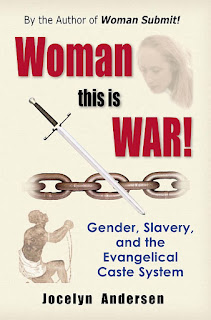
... Woman this is WAR! Gender, Slavery & the Evangelical Caste System: Andersen, Jocelyn: 9780979429323: Amazon.com: Books

What readers are saying:

"This book is well written, well researched, and a real eye opener."

"Andersen is a gifted writer, and the book was easy to read even as it covers thoughtful and sometimes technical information. I am glad I read it. I’ve read a great deal about women in the church and home, and it is easy to think there is nothing new to be learned or considered – but this book has a unique approach and covers aspects overlooked by others. Everything is well documented with footnotes in case you have questions or want sources."

"The author is not only a gifted writer but clearly well-studied and informed."

" I was pleased that translation bias was covered in a chapter, an issue that needs to be addressed, and one that I find quite hard to bring up with lay people or everyday believers who lack knowledge about Bible translation. We can trust our Bibles, but we also need to acknowledge that certain passages are difficult to translate and bias can come into play."

"Andersen tackles most of the primary the teachings of complementarianism with an impressive exegesis"


 Author and speaker, Jocelyn Andersen, is an eclectic Christian writer. She is a Bible teacher who writes about many subjects including Bible prophecy and equality of the sexes. She is best known for her advocacy in domestic violence awareness. Her book, Woman Submit! Christians & Domestic Violence, has been a staple in the library of resources on that subject.  

If the topic of God and Women interests you, join the conversation HERE.

To receive an announcement from Amazon whenever a new book is released by Jocelyn Andersen, subscribe to Her Amazon author's page.

To Contact Jocelyn: Use the contact form in the sidebar of her blog at www.jocelynandersen.com to leave comments on her books, to reach her with questions, or to request for her to come and speak at your group. 

While I was writing WOMAN SUBMIT!


 Q: How difficult was it for you to write Woman Submit? 

A: At first, it was very difficult. I share in the acknowledgments section of the book that "The subject of domestic violence is not a subject I would normally choose to immerse myself in. God knows it is only by His grace that I was able to complete this work at all. I confess I set it down and allowed it to collect dust far too often while burying myself in other projects." 
 
When I finally got serious about writing the book, I began going through my journals and found that I had already written a rough draft of approximately ten chapters, which is how many chapters the finished book has. Most of what went into the first draft had been written over a period of several years while still living in the crucible of abuse. 
 

It was an emotionally charged project for me, but I felt a burden to speak up and to do it quickly. It took me almost four years from the events described in chapter one to write and publish Woman Submit! During the interval,  according to 2005 FBI statistics, over 4000 women died from domestic violence.


Do you have a question about domestic violence or Jocelyn's book, Woman Submit!? Leave it in the comment section.


Read Jocelyn's full interview HERE.


... 
Woman Submit! Christians & Domestic Violence: Andersen, Jocelyn: 9780979429309: Amazon.com: Books

Author and speaker, Jocelyn Andersen, is an eclectic Christian writer. She is a Bible teacher who writes about many subjects including Bible prophecy and equality of the sexes. She is best known for her advocacy in domestic violence awareness. Her book, Woman Submit! Christians & Domestic Violence, has been a staple in the library of resources on that subject.  

To receive Jocelyn's newsletters, subscribe HERE.

To receive an announcement from Amazon whenever a new book is released by Jocelyn Andersen, subscribe to Her Amazon author's page.

To Contact Jocelyn: Use the contact form in the sidebar of her blog at www.jocelynandersen.com to leave comments on her books, to reach her with questions, or to request for her to come and speak at your group.


Is Jocelyn Andersen a Domestic Violence Coach or Counselor?


 One of my LinkedIn connections asked me if I was a DV coach or counselor as well as an author/advocate in raising awareness and educating on Christian response to domestic violence.

The picture (above/left) is me (far right) with an anonymous litigating Protective Mom (far left) and protective mother Amanda Joy (middle). We attended the 2008 Battered Mothers Custody Conference together. Our tee shirts read "SHINE A LIGHT ON DOMESTIC VIOLENC."

I write to increase awareness and occasionally speak. Most recently, I have been invited to speak at a church luncheon in the FL Panhandle.

I don't professionally counsel or coach victims. I do what I can, and I don't hesitate to refer to local resources, DV hotlines, or to the national hotline if a local one is not available. There is much more we can do, but in some cases, referring to the hotline and shelter is the only safe thing (for all involved--including the advocate...even if a relative) to do.


One awesome advocate, who is a survivor and very good friend of mine, was helped by her local hotline where she was counseled for quite some time before being helped to escape from her abusive and violent husband. She then lived in the shelter for months.


She sought help from her church leadership before calling the local domestic violence hotline, but they refused to help her because her abuser was the youth pastor there. 


I save the number to the National Domestic Violence Hotline, along with numbers to local hotlines, shelters, and resources in my phone contacts and advise others to do the same, especially pastors. It's not a Christian cop-out to do this, and it could save lives.

National Domestic Violence Hotline 800.799.SAFE (7233)


Early in my advocacy I spearheaded a project to empower Church leaders and lay-Christians to respond knowledgeably, compassionately, and biblically to victims of DV. I received an overwhelmingly positive response from church members, but not a single pastor responded. The church members who were interested in heading the project at their churches couldn't get it past their pastor's desks. 


Here is a link to the original press release

http://www.christiannewswire.com/news/782355128.html


Here is a link to a more detailed announcement another advocate wrote about the project. It's a shame the project was stalled by church leaders. That was in 2008. Maybe it was before its time. Maybe I should try again. What do you think? https://ajoyrn.tripod.com/

First century wives and slaves: No legal recourse for either


 5: Slaves obey lords according to the flesh with fear  and trembling[1] in singleness of your hearts as [to] Christ

Ephesians 6:5


[1] The apostle meant what he said to Christian slaves about fear and trembling before their masters. Slaves were considered sub-human, and Roman Lords could do anything they liked with their slaves. They could harm or kill them in any manner they chose. Paul was not condoning slavery when he wrote this but rather was intent on the physical safety of those in his congregations who were slaves.

The standing of women in Roman society [and in Jewish tradition] was only slightly higher than that of slaves. Women were honored and respected in the Hebrew scriptures, but not in the Tradition’s. Jesus had nothing good to say about the Traditions, so Paul would have been concerned for the physical safety of the wives in his congregations as well, hence his warning for wives to fear their husbands.

Christian women of the first century experienced an equality of the sexes almost unheard of in all of history [before and after that era]. This liberty would certainly pose a physical threat to wives of violent controlling husbands. Such men would not tolerate wives who dared to exhibit personal autonomy. This liberty among early Christians would naturally have the effect of escalating tension. Violence would have increased in such marriages. 

One shudders to think what the domestic violence mortality rate of first century women must have been. The apostle knew this. He also knew there was no [or limited] legal recourse in cases of violence against women, as “domestic violence” was not part of first century legal jargon.

This is an excerpt from The Hungry Hearts Bible Commentary edited by this author.


 ... 
Woman this is WAR! Gender, Slavery & the Evangelical Caste System: Andersen, Jocelyn: 9780979429323: Amazon.com: Books

What readers are saying:

"This book is well written, well researched, and a real eye opener."

"Andersen is a gifted writer, and the book was easy to read even as it covers thoughtful and sometimes technical information. I am glad I read it. I’ve read a great deal about women in the church and home, and it is easy to think there is nothing new to be learned or considered – but this book has a unique approach and covers aspects overlooked by others. Everything is well documented with footnotes in case you have questions or want sources."

"The author is not only a gifted writer but clearly well-studied and informed."

" I was pleased that translation bias was covered in a chapter, an issue that needs to be addressed, and one that I find quite hard to bring up with lay people or everyday believers who lack knowledge about Bible translation. We can trust our Bibles, but we also need to acknowledge that certain passages are difficult to translate and bias can come into play."

"Andersen tackles most of the primary the teachings of complementarianism with an impressive exegesis"

Woman this is WAR! Gender, Slavery & the Evangelical Caste System: Andersen, Jocelyn: 9780979429323: Amazon.com: Books


 Author and speaker, Jocelyn Andersen, is an eclectic Christian writer. She is a Bible teacher who writes about many subjects including Bible prophecy and equality of the sexes. She is best known for her advocacy in domestic violence awareness. Her book, Woman Submit! Christians & Domestic Violence, has been a staple in the library of resources on that subject.  

If the topic of God and Women interests you, join the conversation HERE.

To receive an announcement from Amazon whenever a new book is released by Jocelyn Andersen, subscribe to Her Amazon author's page.

To Contact Jocelyn: Use the contact form in the sidebar of her blog at www.jocelynandersen.com to leave comments on her books, to reach her with questions, or to request for her to come and speak at your group.